 …
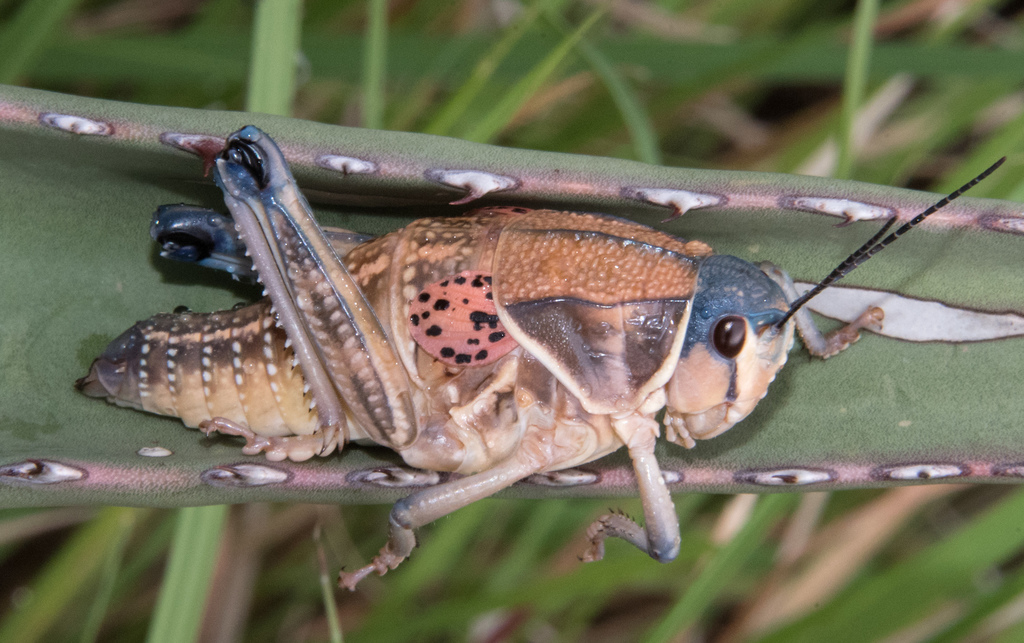
Plains Lubber Grasshopper
Brachystola magna
Insectstrong against fungi, fish
Common
Swarm
While active with another insect in play, each of its attacks also hits the opposing bench for 10, without knocking them out (20 with two others).
30

34
Plains Lubber Grasshopper
Brachystola magna
Insectstrong against fungi, fish
Common
While active with another insect in play, each of its attacks also hits the opposing bench for 10, without knocking them out (20 with two others).
Brachystola magna
Photo: © Don Loarie (original photo) · CC BY 4.0 (licence text) · cropped
Strong against: it deals 20% more damage to them. Weak against: these types deal 20% more damage to it.
Brachystola magna, the plains lubber grasshopper, western lubber grasshopper or homesteader, is a large species of grasshopper in the family Romaleidae, native to open and semi-open habitats of central and southern United States and northern Mexico.
Adults are typically 4–6 cm (1.6–2.4 in) long, with females growing larger than males. It is reddish brown with black dots on its outer wings, however there is some variation in coloration, with more northern variants tending to be greener, and southern ones more brownish-buff. Brachystola magna has extremely small wings and is unable to fly. The antennae are bluish-brown and the legs are reddish near the body with purple tarsi. It has a ridge along the upper and middle region of the abdomen. It is distinguished from Brachystola virescens by its longer antennae and color.
In Wyoming it is found on gravelly ground in the southwest of the state. It does not cause significant damage to crops, and seems to prefer coarse broadleaved plants to crops. It overwinters in the egg, which hatch in the spring and reach adulthood in August.
Walter Sutton's description of reduction division was based on studying the spermatocytes of Brachystola magna. This work was critical in the development of the chromosome theory of inheritance.
Excerpt from the Wikipedia article Brachystola magna, by its authors, under the CC BY-SA 4.0 licence.
No global status on the IUCN Red List: that’s what makes this card Common.
Every Common card has 100 points, shared between HP, ATK and DEF:
How they’re shared out:

 DEF 34