 …
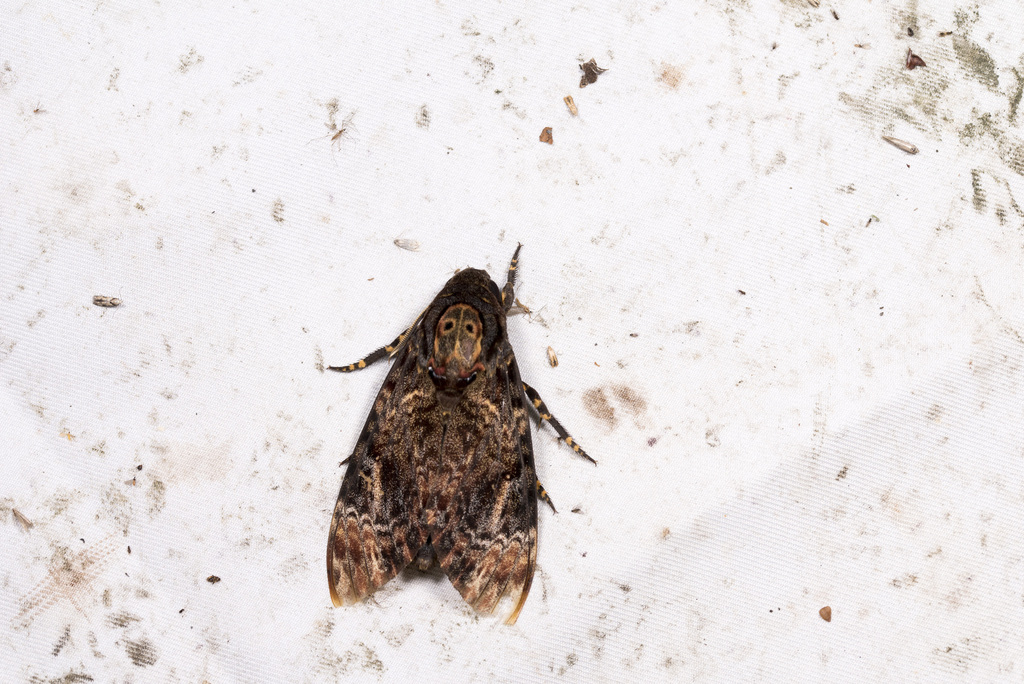
Greater Death's Head Hawkmoth
Acherontia lachesis
Insectstrong against fungi, fish
Common
Swarm
While active with another insect in play, each of its attacks also hits the opposing bench for 10, without knocking them out (20 with two others).
38

38
Greater Death's Head Hawkmoth
Acherontia lachesis
Insectstrong against fungi, fish
Common
While active with another insect in play, each of its attacks also hits the opposing bench for 10, without knocking them out (20 with two others).
Acherontia lachesis
Photo: © Licheng Shih (original photo) · CC BY 4.0 (licence text) · cropped
Strong against: it deals 20% more damage to them. Weak against: these types deal 20% more damage to it.
Acherontia lachesis, the greater death's head hawkmoth or bee robber, is a large (up to 13 cm wingspan) sphingid moth found in India, Sri Lanka and much of the East Asian region. It is one of the three species of death's-head hawkmoth genus, Acherontia. The species was first described by Johan Christian Fabricius in 1798. It is nocturnal and very fond of honey; they can mimic the scent of honey bees so that they can enter a hive unharmed to get honey. Their tongue, which is stout and very strong, enables them to pierce the wax cells and suck the honey out. This species occurs throughout almost the entire Oriental region, from India, Pakistan and Nepal to the Philippines, and from southern Japan and the southern Russian Far East to Indonesia, where it attacks colonies of several different honey bee species. It has recently become established on the Hawaiian Islands.
Excerpt from the Wikipedia article Acherontia lachesis, by its authors, under the CC BY-SA 4.0 licence.
No global status on the IUCN Red List: that’s what makes this card Common.
Every Common card has 100 points, shared between HP, ATK and DEF:
How they’re shared out:

 DEF 38