 …
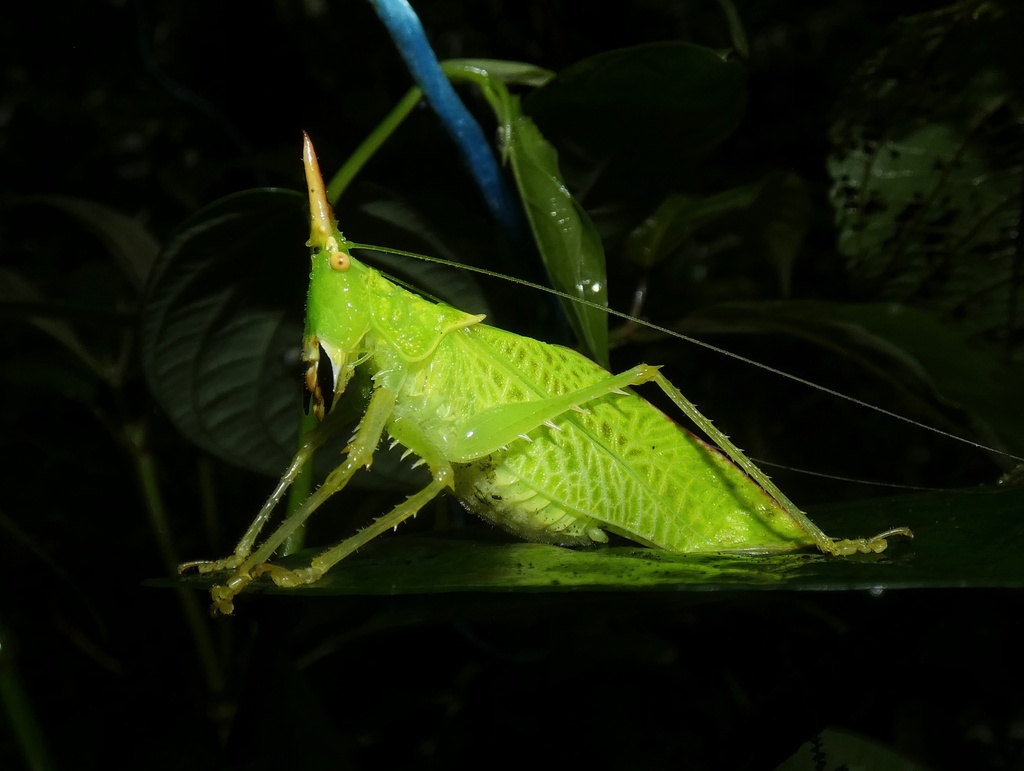
Rhinoceros Katydid
Copiphora rhinoceros
Insectstrong against fungi, fish
Common
Swarm
While active with another insect in play, each of its attacks also hits the opposing bench for 10, without knocking them out (20 with two others).
29

36
Rhinoceros Katydid
Copiphora rhinoceros
Insectstrong against fungi, fish
Common
While active with another insect in play, each of its attacks also hits the opposing bench for 10, without knocking them out (20 with two others).
Copiphora rhinoceros
Photo: © Kai Squires (original photo) · CC BY 4.0 (licence text) · cropped
Strong against: it deals 20% more damage to them. Weak against: these types deal 20% more damage to it.
Copiphora rhinoceros, the rhinoceros katydid, is a relatively large, up to about 7.5 cm (3 in) long, species of katydid found in Central America. It belongs to a group known as the conehead katydids, several of which have a horn-like projection on the top of the head. The horn of the rhinoceros katydid is used to ward off attacks from hungry bats. Unlike most katydids, which are herbivores, the rhinoceros katydid is an omnivore, feeding on fruit, seeds, flowers, invertebrates, frog eggs and small lizards. The species can be quite noisy during the night and produces one of the dominant sounds in Central American lowland forests. Its lifespan is one to two years.
It was first described in 1888 by Alphonse Pictet in his Locustides Nouveaux ou peu connus de Musée de Genève (New or Little-known Locusts of the Geneva Museum).
Excerpt from the Wikipedia article Copiphora rhinoceros, by its authors, under the CC BY-SA 4.0 licence.
No global status on the IUCN Red List: that’s what makes this card Common.
Every Common card has 100 points, shared between HP, ATK and DEF:
How they’re shared out:

 DEF 36