 …
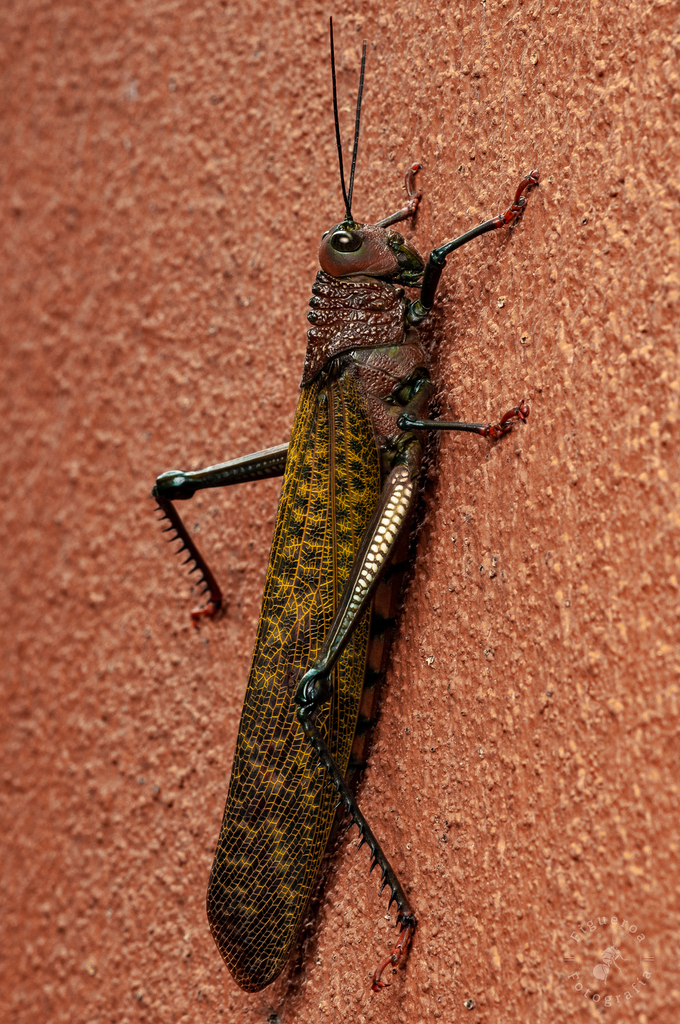
giant red-winged grasshopper
Tropidacris cristata
Insectstrong against fungi, fish
Common
Swarm
While active with another insect in play, each of its attacks also hits the opposing bench for 10, without knocking them out (20 with two others).
32

35
giant red-winged grasshopper
Tropidacris cristata
Insectstrong against fungi, fish
Common
While active with another insect in play, each of its attacks also hits the opposing bench for 10, without knocking them out (20 with two others).
Tropidacris cristata
Photo: © Federico Figueroa Cabezas (original photo) · CC BY 4.0 (licence text) · cropped
Strong against: it deals 20% more damage to them. Weak against: these types deal 20% more damage to it.
Tropidacris cristata, the giant red-winged grasshopper, is a widespread species of lubber grasshopper in the family Romaleidae from tropical South and Central America, and Mexico. It is among the largest grasshoppers in the world by length and wingspan, reaching up to 14.5 cm (5.7 in) and 24 cm (9.4 in) respectively. More typical adult lengths are 5.5–7 cm (2.2–2.8 in), average 6.5 cm (2.6 in), in males and 7–12 cm (2.8–4.7 in), average 11 cm (4.3 in), in females. As suggested by the common name, adult T. cristata have conspicuously red wings in flight, although the exact red hue varies. The flightless and gregarious nymphs have aposematic dark-and-yellow stripes and are presumed to be toxic.
T. cristata occurs in a wide range of habitats, both in lowlands and highlands. In the southern part of its distribution, it is largely restricted to humid and semi-humid forested regions, avoiding places that are open and dry, but in the northern part it also occurs in somewhat drier habitats. It is generally quite common, although the blue-winged T. collaris often is more common where their ranges overlap in South America (only T. cristata is found in some parts of northwestern South America and in Central America).
Abridged excerpt from the Wikipedia article Tropidacris cristata, by its authors, under the CC BY-SA 4.0 licence.
No global status on the IUCN Red List: that’s what makes this card Common.
Every Common card has 100 points, shared between HP, ATK and DEF:
How they’re shared out:

 DEF 35