 …
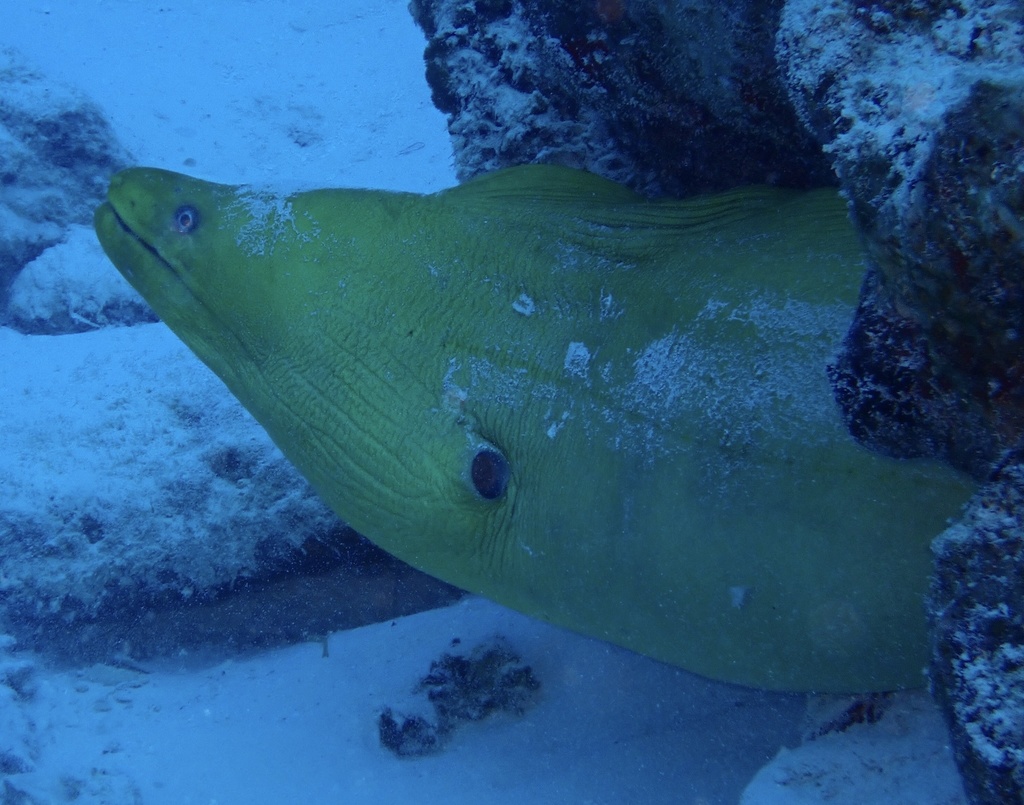
Green Moray
Gymnothorax funebris
Fishstrong against mammals, arachnids
Common
School
While active with another fish in play, a fish on your bench absorbs up to 9 of the damage this card takes, without being knocked out (18 with two others).
30

32
Green Moray
Gymnothorax funebris
Fishstrong against mammals, arachnids
Common
While active with another fish in play, a fish on your bench absorbs up to 9 of the damage this card takes, without being knocked out (18 with two others).
Gymnothorax funebris
Photo: iNaturalist (original photo) · CC0 (licence text) · cropped
Strong against: it deals 20% more damage to them. Weak against: these types deal 20% more damage to it.
The green moray (Gymnothorax funebris) is a moray eel of the family Muraenidae, found in the western Atlantic Ocean from Long Island, New York, to Bermuda, to the northern Gulf of Mexico and to Brazil, at depths down to 40 m (130 ft). With a length up to 2.5 m (8.2 ft), it is the largest moray species of the tropical Atlantic and one of the largest species of moray eels known.
The common name "green moray" is also sometimes used to refer to the yellow moray, G. prasinus. Its green colour comes from a protective layer of mucus secreted by its specialized goblet cells, much like other species of morays. Underneath this mucus layer, the green moray eel is a darker color as can be seen in preserved specimens.
Green morays are typically not eaten and can cause ciguatera fish poisoning. Though the green moray is not considered endangered, moray eels in general are understudied and often undercounted by traditional visual surveys. The green moray is rated as least concern by the IUCN, with no notable threats beyond occasional capture for public aquaria.
Excerpt from the Wikipedia article Green moray, by its authors, under the CC BY-SA 4.0 licence.
Least Concern on the IUCN Red List: that’s what makes this card Common.
Every Common card has 100 points, shared between HP, ATK and DEF:
How they’re shared out:

 DEF 32