 …
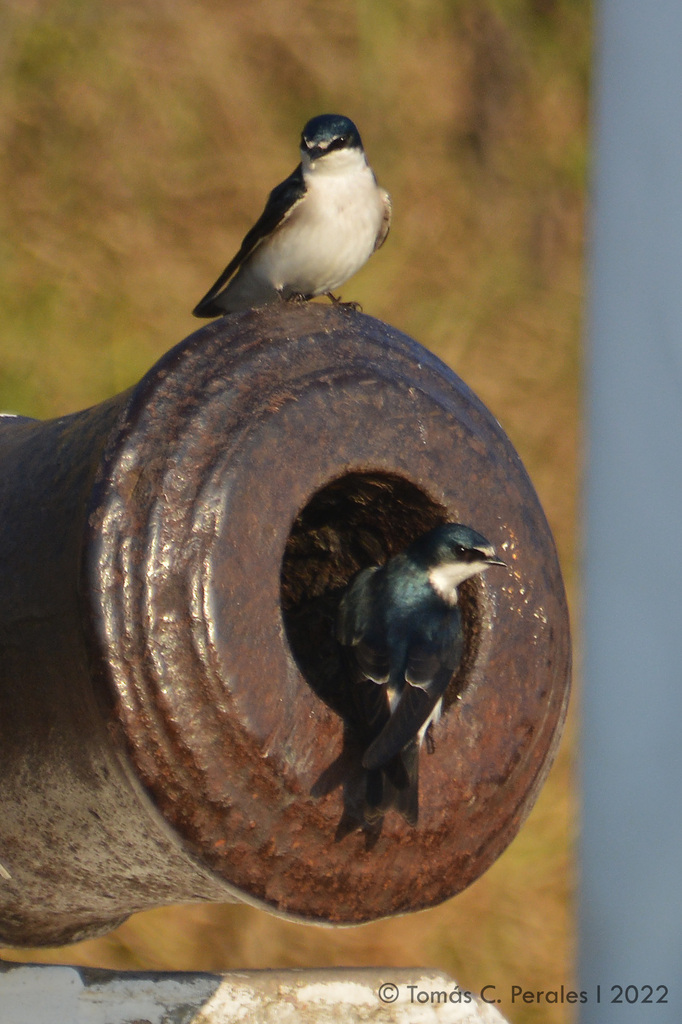
White-rumped Swallow
Tachycineta leucorrhoa
Birdstrong against fish, reptiles
Common
Swoop
While active with another bird in play, it hits 6 harder on its first attack after entering play (12 with two others).
31

40
White-rumped Swallow
Tachycineta leucorrhoa
Birdstrong against fish, reptiles
Common
While active with another bird in play, it hits 6 harder on its first attack after entering play (12 with two others).
Tachycineta leucorrhoa
Photo: © Tomás Carranza Perales (original photo) · CC BY 4.0 (licence text) · cropped
Strong against: it deals 20% more damage to them. Weak against: these types deal 20% more damage to it.
The white-rumped swallow (Tachycineta leucorrhoa) is a species of bird in the family Hirundinidae. First described and given its binomial name by French ornithologist Louis Pierre Vieillot in 1817, it was for many years considered a subspecies of the Chilean swallow. The species is monotypic with no known population variations. It has a white supraloral streak, or streak above its lores (the region between a bird's eye and nostrils), which can be used to differentiate it from the Chilean swallow. The lores, ear coverts, tail, and wings are black, with white tips on the inner secondaries, tertials, and greater coverts of the wings. The rest of the upperparts are a glossy blue. Its underparts and underwing-coverts are white, in addition to the rump, as the name suggests. The sexes are similar, and the juvenile is duller and browner with a dusky breast.
This species usually builds its nest in holes in trees or dead snags or under or in artificial structures like fence posts and the eaves of buildings. The white-rumped swallow is solitary and nests in distributed pairs during the breeding season. The breeding season is from October to December in Brazil and from October to February in neighboring Argentina. Usually, only one brood with four to seven eggs is laid, although a second one will occasionally be laid. The female incubates the eggs over a period usually between 15 and 16 days, with the fledging usually occurring between 21 and 25 days after hatching.
Abridged excerpt from the Wikipedia article White-rumped swallow, by its authors, under the CC BY-SA 4.0 licence.
Least Concern on the IUCN Red List: that’s what makes this card Common.
Every Common card has 100 points, shared between HP, ATK and DEF:
How they’re shared out:

 DEF 40