 …
Fib King
Boletus fibrillosus
Fungusstrong against amphibians, reptiles
Common
Mycelium
While active with another fungus in play, it regains 5 HP at the start of your turn (8 with two others).
37

29
Fib King
Boletus fibrillosus
Fungusstrong against amphibians, reptiles
Common
While active with another fungus in play, it regains 5 HP at the start of your turn (8 with two others).
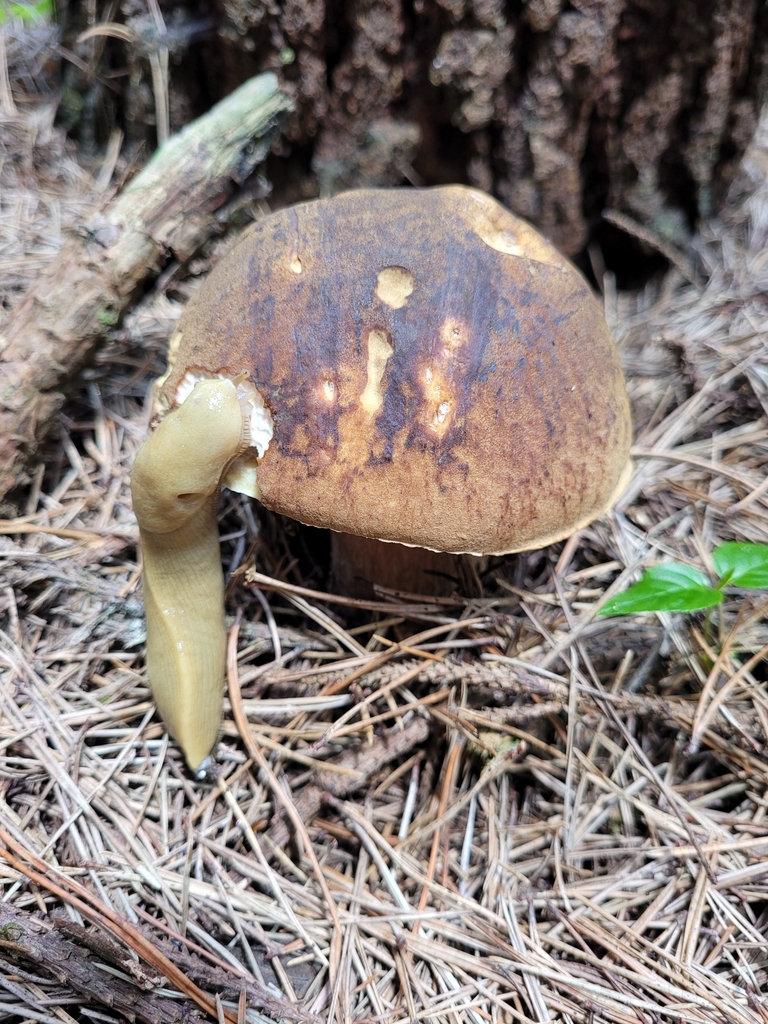
Boletus fibrillosus
Photo: © Mandy Hackney (original photo) · CC BY 4.0 (licence text) · cropped
Strong against: it deals 20% more damage to them. Weak against: these types deal 20% more damage to it.
Boletus fibrillosus, commonly known as the fib king, is a basidiomycete fungus of the genus Boletus. The holotype was collected in Mendocino County, California. Phylogenetic analysis has shown it to be a member of a clade (closely related group) with B. pinophilus, B. regineus, B. rex-veris, B. subcaerulescens, and Gastroboletus subalpinus.
The cap is up to 17 centimetres (6+1⁄2 in) wide and buff to brown to dark brown, with a wrinkled to finely fibrous texture. The tubes are yellow, while the flesh is white to buff and does not stain when cut. The stem is up to 16 cm long, yellowish at the top, brown otherwise, with a reticulate texture, and mycelium enshrouding the bottom.
The species has only been found in western North America. The fruiting bodies are found in mixed coastal forests in the fall, usually singly or in small groups. It is edible, but considered to have inferior taste to other edible boletes such as B. edulis, which it is often confused with.
Excerpt from the Wikipedia article Boletus fibrillosus, by its authors, under the CC BY-SA 4.0 licence.
Least Concern on the IUCN Red List: that’s what makes this card Common.
Every Common card has 100 points, shared between HP, ATK and DEF:
How they’re shared out:

 DEF 29