 …
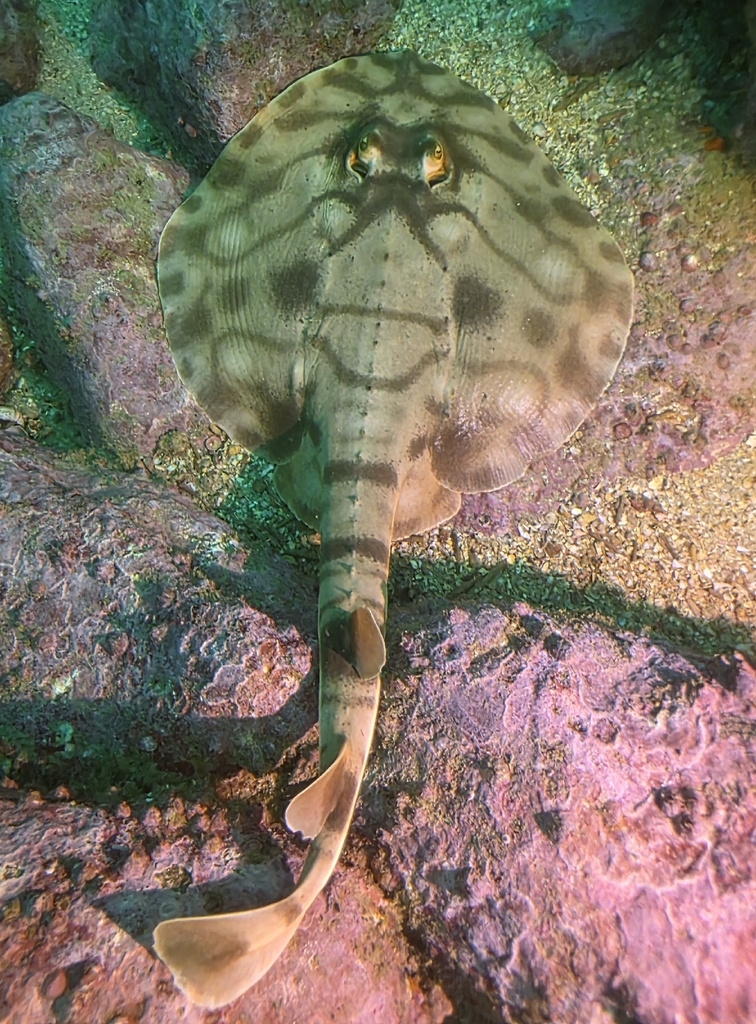
Striped Panray
Zanobatus schoenleinii
Fishstrong against mammals, arachnids
Rare
School
While active with another fish in play, a fish on your bench absorbs up to 9 of the damage this card takes, without being knocked out (18 with two others).
35

51
Striped Panray
Zanobatus schoenleinii
Fishstrong against mammals, arachnids
Rare
While active with another fish in play, a fish on your bench absorbs up to 9 of the damage this card takes, without being knocked out (18 with two others).
Zanobatus schoenleinii
Photo: © Nicola Faulks (original photo) · CC BY 4.0 (licence text) · cropped
Strong against: it deals 20% more damage to them. Weak against: these types deal 20% more damage to it.
Zanobatus schoenleinii, the striped panray, is a species of ray in the family Zanobatidae. It was considered the only species in its genus and family until the description of the Zanobatus maculatus in 2016.
The striped panray is found in the warm East Atlantic Ocean, ranging from Morocco, through the Gulf of Guinea to Angola. It mainly occurs over sandy bottoms at depths of less than 15 m (50 ft), but may occur as deep as 60–100 m (200–300 ft).
Adults are typically 40–50 cm (1.3–1.6 ft) long and the likely maximum length is around 60 cm (2.0 ft), although there have been claims of individuals up to 1 m (3.3 ft). Its upperparts are brownish with a distinct dark blotched and barred pattern. It resembles the maculate panray, but that species is only known from the Gulf of Guinea (Ivory Coast to Gabon), is smaller (up to around 36 cm or 1.18 ft), has a less striped pattern and a more thorny back.
Little is known about the biology of the striped panray and the IUCN has assessed it as being Vulnerable. It feeds on benthic invertebrates and it is ovoviviparous, giving birth to 1–4 young that are about 19 cm (7.5 in) long.
Excerpt from the Wikipedia article Zanobatus schoenleinii, by its authors, under the CC BY-SA 4.0 licence.
Vulnerable on the IUCN Red List: that’s what makes this card Rare.
Every Rare card has 130 points, shared between HP, ATK and DEF:
How they’re shared out:

 DEF 51