 …
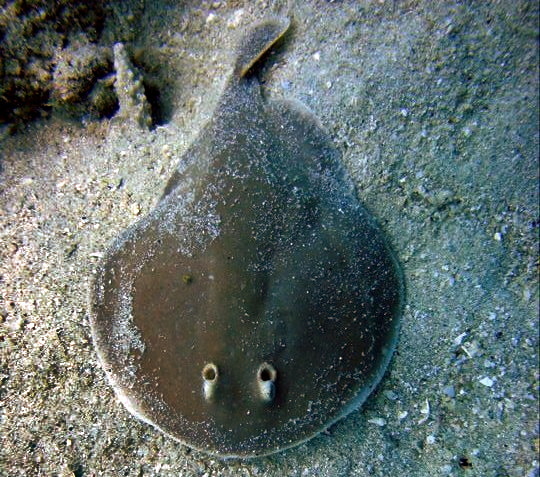
Finless Sleeper Ray
Temera hardwickii
Fishstrong against mammals, arachnids
Rare
School
While active with another fish in play, a fish on your bench absorbs up to 9 of the damage this card takes, without being knocked out (18 with two others).
36

48
Finless Sleeper Ray
Temera hardwickii
Fishstrong against mammals, arachnids
Rare
While active with another fish in play, a fish on your bench absorbs up to 9 of the damage this card takes, without being knocked out (18 with two others).
Temera hardwickii
Photo: © Lee Nean Sing (original photo) · CC BY 4.0 (licence text) · cropped
Strong against: it deals 20% more damage to them. Weak against: these types deal 20% more damage to it.
The finless sleeper ray (Temera hardwickii) is a species of electric ray in the family Narkidae, and the sole member of its genus. It is found over the continental shelf of Southeast Asia from the eastern Andaman Sea to Vietnam and Borneo. Typically growing no more than 15 cm (5.9 in) long, it may be the smallest cartilaginous fish. The finless sleeper ray is the only electric ray that lacks dorsal fins. It has an oval pectoral fin disc that varies from longer than wide to wider than long, depending on age, and a short, robust tail that terminates in a short, deep caudal fin. The trailing margins of its pelvic fins are sexually dimorphic, being more concave in males.
Like other members of its family, the finless sleeper ray can generate a defensive electric shock from paired electric organs in its disc. It gives birth to live young, with the developing embryos nourished by yolk. A litter size of four has been recorded from one individual. The International Union for Conservation of Nature (IUCN) has assessed the finless sleeper ray as Vulnerable. This slow-reproducing species is caught by intensive bottom trawl and possibly other fisheries throughout its range, which likely cause high mortality regardless of whether it is discarded or utilised.
Excerpt from the Wikipedia article Finless sleeper ray, by its authors, under the CC BY-SA 4.0 licence.
Vulnerable on the IUCN Red List: that’s what makes this card Rare.
Every Rare card has 130 points, shared between HP, ATK and DEF:
How they’re shared out:

 DEF 48