
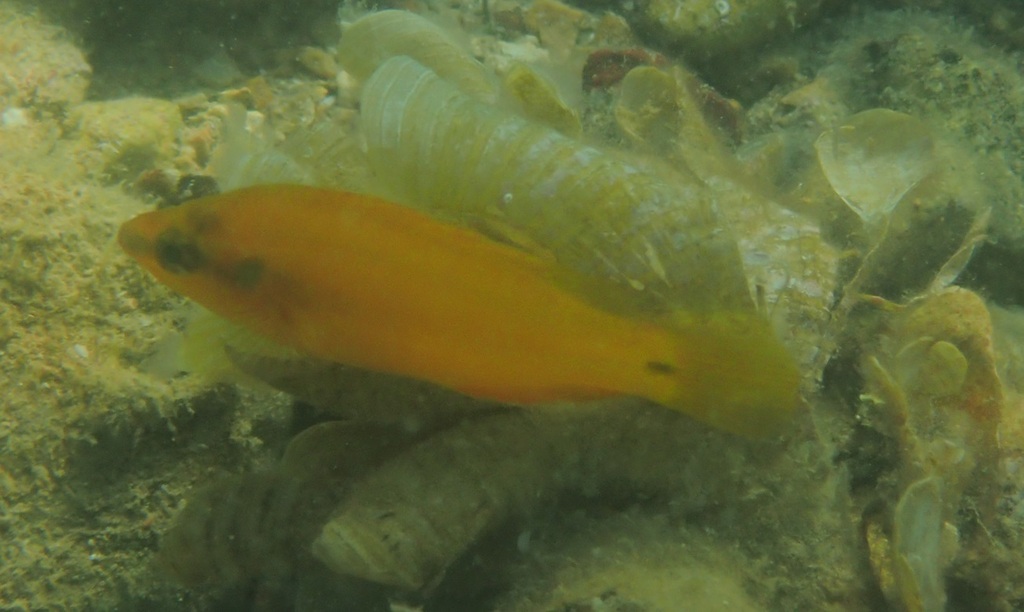
Ocellated Wrasse
Symphodus ocellatus
Fishstrong against mammals, arachnids
Common
While active with another fish in play, a fish on your bench absorbs up to 9 of the damage this card takes, without being knocked out (18 with two others).

Ocellated Wrasse
Symphodus ocellatus
Fishstrong against mammals, arachnids
Common
While active with another fish in play, a fish on your bench absorbs up to 9 of the damage this card takes, without being knocked out (18 with two others).
Symphodus ocellatus
Photo: © amfstocker (original photo) · CC BY 4.0 (licence text) · cropped
Strong against: it deals 20% more damage to them. Weak against: these types deal 20% more damage to it.
The ocellated wrasse (Symphodus ocellatus) is a species of wrasse native to the eastern Atlantic Ocean and throughout the Mediterranean Sea, the Black Sea, and the Sea of Azov. It inhabits areas with rocks and eelgrass at depths from 1 to 30 m (3.3 to 98.4 ft). It feeds on various marine invertebrates. This species can reach 12 cm (4.7 in) in standard length. It can also be found in the aquarium trade.
These fish live about two to three years. There are three distinct male forms. There are nesting males, sneaker males, and satellite males. The nesting males are the largest of the three and the most brightly colored. The sneaker males are the smallest of the three types and the most dull in color, and actually closely resemble the female phenotype. Satellite males are an intermediate in size and color between the large nesting male and smaller sneaker male.
Nesting males court females, build and guard nests, and provide parental care for the offspring. Nests are made of harvested algae. Sneaker males do not court females, do not provide parental care and they join in when a female and nesting male are mating in an attempt to fertilize the eggs before the nesting male. Satellite males assist in courting the females, they chase away sneaker males, but they do not provide parental care for the offspring.
Abridged excerpt from the Wikipedia article Ocellated wrasse, by its authors, under the CC BY-SA 4.0 licence.
Least Concern on the IUCN Red List: that’s what makes this card Common.
Every Common card has 100 points, shared between HP, ATK and DEF:
How they’re shared out:

