
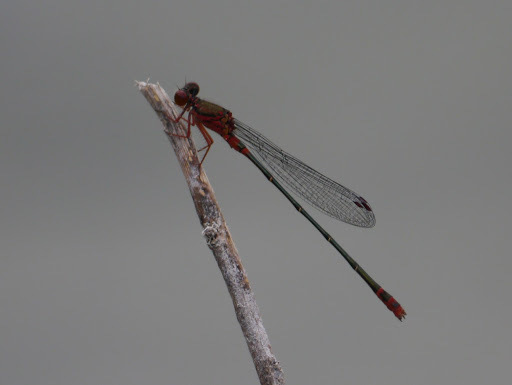
Orangeblack Hawaiian Damselfly
Megalagrion xanthomelas
Insectstrong against fungi, fish
Epic
While active with another insect in play, each of its attacks also hits the opposing bench for 10, without knocking them out (20 with two others).
Orangeblack Hawaiian Damselfly
Megalagrion xanthomelas
Insectstrong against fungi, fish
Epic
While active with another insect in play, each of its attacks also hits the opposing bench for 10, without knocking them out (20 with two others).
Megalagrion xanthomelas
Photo: © 116916927065934112165 (original photo) · CC BY 4.0 (licence text) · cropped
Strong against: it deals 20% more damage to them. Weak against: these types deal 20% more damage to it.
Megalagrion xanthomelas (orangeblack Hawaiian damselfly) is a species of damselfly in the order Odonata and the family Coenagrionidae. The species was first found by G. F. Matthew and described in 1876 by Selys-Longchamps. Classified as an endemic species, the orangeblack Hawaiian damselfly can only be found in the forests of the Hawaiian Islands. Derived from a freshwater ancestor, the genus Megalarion consists of very diversified groups of damselflies that can grow between the lengths of 33 to 37 millimeters. Megalagrion xanthomelas are commonly found in calm water sources throughout Hawaii including streams and ponds and is threatened by habitat loss. Anchialine ponds are a common habitat for Megalagrion xanthomelas to live in which requires the species to adapt to mechanisms of osmoregulation, which helps maintain their internal fluids when the surrounding salinity of the water fluctuates. Osmoregulation resulted in the species adapting behaviorally to finding habitats that have lower salinity levels. Osmoregulation leads to an increase in diversity within the species causing western coast populations to adapt and be less sensitive to higher salinity habitats, creating a salinity tolerance, while eastern coast populations lack a high salinity tolerance.
Abridged excerpt from the Wikipedia article Megalagrion xanthomelas, by its authors, under the CC BY-SA 4.0 licence.
Endangered on the IUCN Red List: that’s what makes this card Epic.
Every Epic card has 145 points, shared between HP, ATK and DEF:
How they’re shared out:

