 …
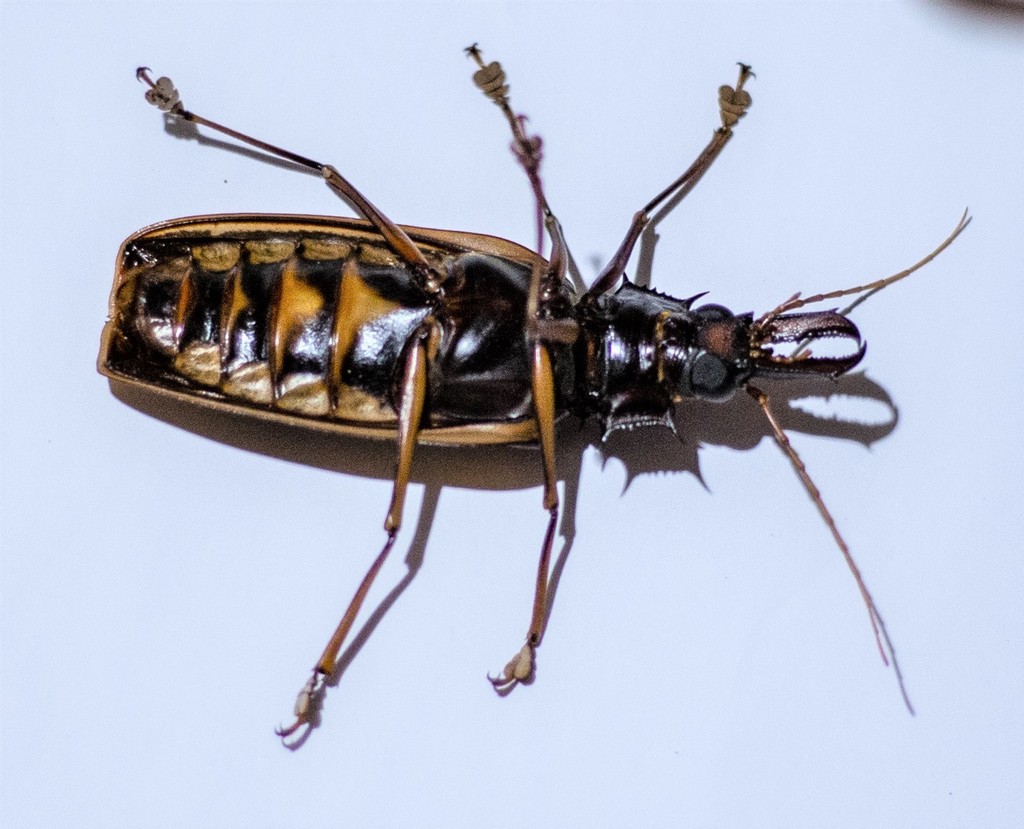
Giant Jawed Sawyer
Macrodontia cervicornis
Insectstrong against fungi, fish
Rare
Swarm
While active with another insect in play, each of its attacks also hits the opposing bench for 10, without knocking them out (20 with two others).
36

51
Giant Jawed Sawyer
Macrodontia cervicornis
Insectstrong against fungi, fish
Rare
While active with another insect in play, each of its attacks also hits the opposing bench for 10, without knocking them out (20 with two others).
Macrodontia cervicornis
Photo: © Gerry van Tonder (original photo) · CC BY 4.0 (licence text) · cropped
Strong against: it deals 20% more damage to them. Weak against: these types deal 20% more damage to it.
Macrodontia cervicornis (Linnaeus, 1758), also known as the sabertooth longhorn beetle, is one of the largest beetles, if one allows for the enormous mandibles of the males, from which it derives both of the names in its binomen: Macrodontia means "long tooth", and cervicornis means "deer antler". Measurements of insect length normally exclude legs, jaws, or horns, but if jaws are included, the longest known specimen of M. cervicornis is 17.7 cm; the longest known specimen of Dynastes hercules, a beetle species with enormous horns, is 17.5 cm, and the longest known beetle excluding either jaws or horns is Titanus giganteus, at 16.7 cm.
Most of this species' life is spent in the larval stage, which can last up to 10 years, while its adult phase is likely to last no more than a few months during which time dispersal and reproduction take place. The female lays eggs under the bark of dead or dying softwood trees, and once hatched, the larvae burrow into the rotting wood, creating extensive galleries over a metre long and 10 cm wide.
Excerpt from the Wikipedia article Macrodontia cervicornis, by its authors, under the CC BY-SA 4.0 licence.
Vulnerable on the IUCN Red List: that’s what makes this card Rare.
Every Rare card has 130 points, shared between HP, ATK and DEF:
How they’re shared out:

 DEF 51