
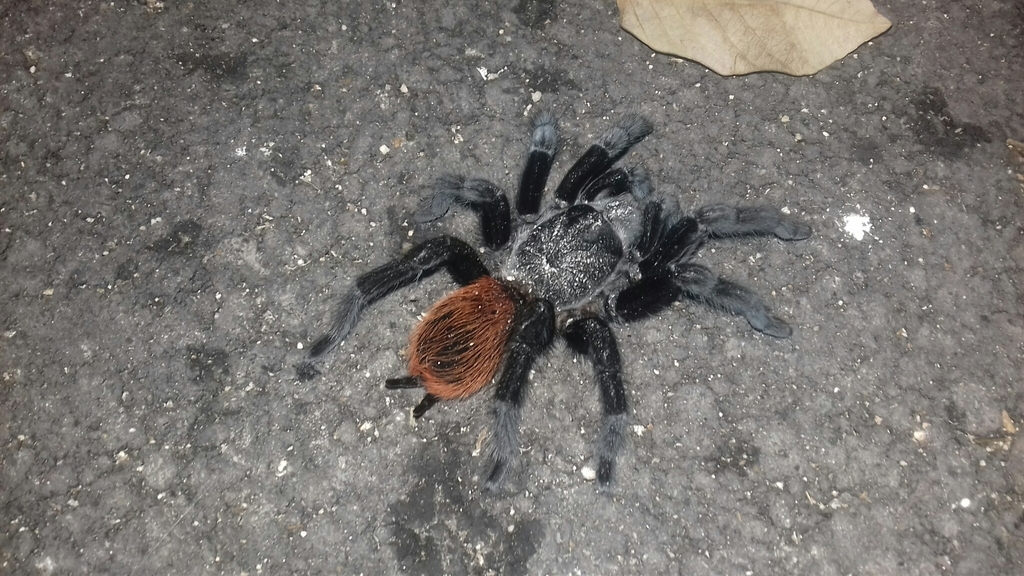
Mexican Red-rump Tarantula
Tliltocatl vagans
Arachnidstrong against insects, birds
Common
While active with another arachnid in play, its target loses 4 HP at the start of each of its turns, as long as it stays active (7 with two others).

Mexican Red-rump Tarantula
Tliltocatl vagans
Arachnidstrong against insects, birds
Common
While active with another arachnid in play, its target loses 4 HP at the start of each of its turns, as long as it stays active (7 with two others).
Tliltocatl vagans
Photo: © AJ Wacaser (original photo) · CC BY 4.0 (licence text) · cropped
Strong against: it deals 20% more damage to them. Weak against: these types deal 20% more damage to it.
Tliltocatl vagans (synonym Brachypelma vagans) is a species of tarantula known commonly as the Mexican red rump. It ranges predominantly in Mexico (including the Yucatán Peninsula), but is also found in Central America. They are terrestrial, burrowing spiders. The reason for the name red rump is because of its distinctive red hairs on its abdomen. Like most tarantulas, they will eat anything they can overpower, which is usually insects, but small lizards and rodents may also be consumed. They can grow up to a solid 6.5 inch leg span, with males typically being smaller and thinner than the females. They prefer shrubland habitats.
In 1996, Tliltocatl vagans was discovered in the wild in St. Lucie County, Florida. It is now considered an established non-native species in that state, where it is thought to have been introduced through either accidental or intentional releases of specimens imported via the pet trade, although their numbers have been dwindling due to many T. vagans eating insects poisoned by pesticides.
Excerpt from the Wikipedia article Tliltocatl vagans, by its authors, under the CC BY-SA 4.0 licence.
Least Concern on the IUCN Red List: that’s what makes this card Common.
Every Common card has 100 points, shared between HP, ATK and DEF:
How they’re shared out:

