 …
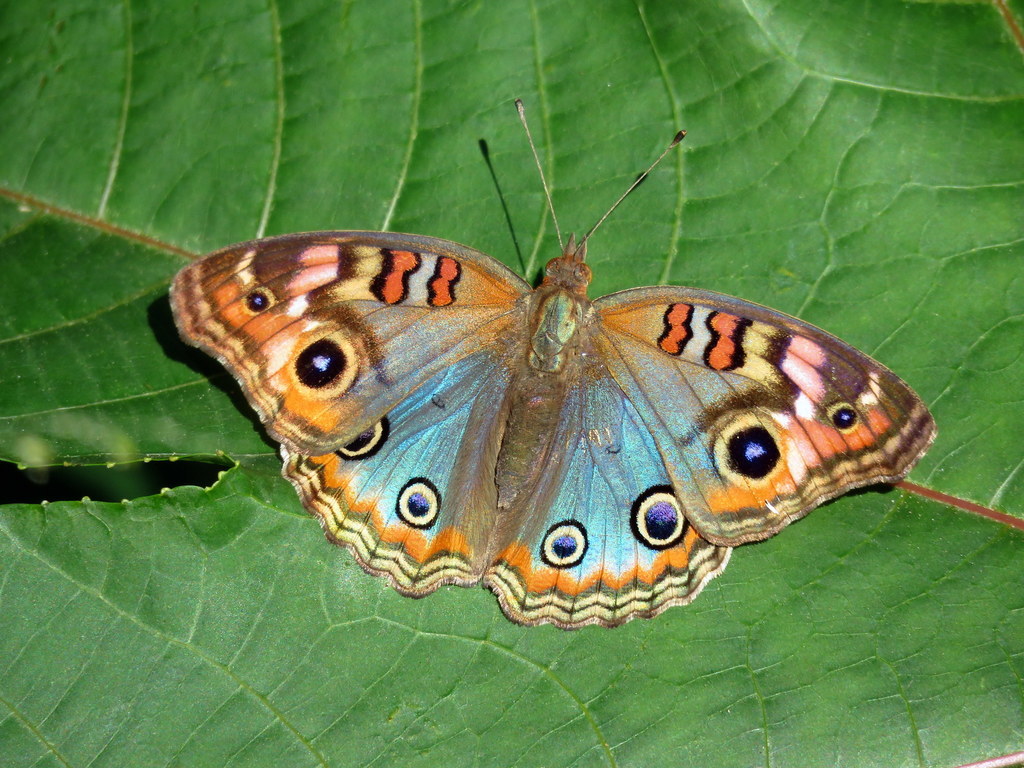
Common Mangrove Buckeye
Junonia genoveva
Insectstrong against fungi, fish
Common
Swarm
While active with another insect in play, each of its attacks also hits the opposing bench for 10, without knocking them out (20 with two others).
40

37
Common Mangrove Buckeye
Junonia genoveva
Insectstrong against fungi, fish
Common
While active with another insect in play, each of its attacks also hits the opposing bench for 10, without knocking them out (20 with two others).
Junonia genoveva
Photo: Diego Carús (original photo) · CC0 (licence text) · cropped
Strong against: it deals 20% more damage to them. Weak against: these types deal 20% more damage to it.
Junonia genoveva, the common mangrove buckeye or mangrove buckeye, is a butterfly of the family Nymphalidae. The species was first described by Pieter Cramer in 1780. It is found in South America and possibly into Central America. The wingspan is 45–57 mm.
The butterfly is easily confused with Junonia evarete, the tropical buckeye, also found in South America. Not only have the common names mangrove and tropical buckeye been confused, but the two species of butterflies themselves have been sometimes misidentified in past literature. Recent consensus designates Junonia genoveva the mangrove buckeye and Junonia evarete the tropical buckeye. Recent research and reclassification has determined that these species occur in South America.
The species Junonia neildi, the West Indian mangrove buckeye, was formerly considered a subspecies of Junonia genoveva. Its split from Junonia genoveva leaves Junonia genoveva as a South American species. The only members of the genus Junonia currently found in Florida are Junonia neildi, Junonia coenia, and Junonia zonalis.
Abridged excerpt from the Wikipedia article Junonia genoveva, by its authors, under the CC BY-SA 4.0 licence.
No global status on the IUCN Red List: that’s what makes this card Common.
Every Common card has 100 points, shared between HP, ATK and DEF:
How they’re shared out:

 DEF 37